Friday, 6 June 2025

The Art of Literary Research

This blog is part of the Ph.D. Coursework Task which was to watch videos Prepared by Dr. Dilip Barad sir, based on the Book 'The Art of Literary Research' by Richard D. Altick.

Video 1 Critic, Researcher and Scholar


Academic writing has two ways of looking, the first one is  the technical aspects of writing and data collection and the second is the Mind set, that can be called the ‘software’ part, which involves understanding the roles of the critic, researcher, and scholar. While these terms are often used interchangeably, particularly ‘researcher’ and ‘scholar’, it is possible to differentiate them. One individual can embody all three roles depending on their approach to a text or topic.

Critic vs. Scholar

Some students of literature prefer to see themselves primarily as critics, while others identify as scholars. However, the distinction between the two is described as far more apparent than real, and every good student of literature constantly combines these roles, often without realising it. The difference between a critic and a scholar is primarily one of emphasis.


Critic

Scholar

The literary scholar and the critic are engaged in a common pursuit. Their pursuits are common, and the findings of one are indispensable for the other. 

A critic might use the findings or interpretations of scholars,

While a scholar cannot interpret without reading the text, which is what a critic necessarily does.

The critic is primarily concerned with the literary work itself

The scholar, on the other hand, is more concerned with the facts attending the literary work's genesis and subsequent history. 

They study the style, structure, content, and ideas of a literary text. 

A scholar locates a particular work in a larger context, seeing it from "without as well as within". 

The critic's concern is seen as having a narrow insight into the work, although this is necessary for any reader or scholar.

They seek to illuminate the work from every conceivable angle by uncovering and applying data residing outside the work itself.

Being a scholar is something Higher or expanding the horizon compared to being only a critic.


The activities of the critic ultimately benefit criticism, while the activities of the scholar ultimately benefit literary history.

New Criticism or Practical Criticism being more aligned with the critic's role, focusing on particular criticism or developing theories. Northrop Frye, who sought a common skeleton in world literature and a larger context, is offered as an example aligning with the scholar's approach.

George Whalley, in his work ‘Scholarship and Criticism’ (1959), observes that 'No true scholar can lack critical acumen; and the scholar’s eye is rather like the poet’s – not, to be sure, “in a fine frenzy rolling,” but at least looking for something as yet unknown which it knows it will find, with perceptions heightened and modified by the act of looking. For knowing is qualitative and is profoundly affected by the reason for wanting to know. Again, it is clear that no critic can afford not to be a scholar – even a scholar in a pretty impressive degree – if his work is to go much beyond delicate impressionism, penumbral rhetoric, or marginal schematism. Without scholarship every synoptic view will be cursory, every attempt at a synthesis a wind-egg; without scholarship the criticism of a poem may easily become a free fantasia on a non-existent theme (Whalley).' 

At the end we can say that a scholar's work requires a theoretical framework and the ability to locate work in the larger context of theories, discourses, genesis, or history. Starting research from the genesis or historical perspective is presented as more important than merely starting from a text based on personal liking.


What is essential to be a Researcher

  • The researcher must have a vivid sense of history. This is the ability to cast themselves back into another age, which includes time, but also discipline or subject

  • Researchers must adjust their intellectual insights and imaginative response to the system of thought and social/cultural atmosphere of the past. This involves being able to think and fantasise as people did in those times to comprehend current attitudes or artistic assumptions that guided an author. Intellectual insights are needed to support interpretations with evidence, avoiding mere fantasia.

  • While the researcher travels back into the past, the scholar must retain their footing in the 21st century for the sake of indispensable perspective. The essence of the past needs to be understood and used in the present. This implies the researcher, who also has scholar’s qualities, must have a double vision: the vastness of the past and its use in the present.

  • The researcher is one who is rooted in today but can time travel into the past, understand the "pastness of the past," and quickly see this pastness in the present time. They need both complete attachment with the past and detachment to quickly move between the past and the present.


Qualities that a Literary Scholar/Researcher Must have 

The literary scholar/researcher needs to be as rigorous as scientists in their method and that  requires certain qualities, which are also valuable for literary research and that are,

  • Intellectual curiosity, 

  • Shrewdness, 

  • Precision, 

  • Imagination

  • and lively inventiveness.

These qualities help in suggesting new hypotheses, strategies, and sources of information, and enable the accurate interpretation and evaluation of data.


Video 2 Mind and Temperament of Research Scholar


Someone who is engaging in Research , they must have ‘making of the mind’ of the research scholar, dealing with the mental capacities and soft skills needed for research. A rewarding research work is one you are eager and keen to talk about, where you know you have done something significant, added to knowledge systems, or contributed in a newer way. It involves someone being interested in inviting you to speak and listen about your work.


For a rewarding research project the researcher must have- 

  • A fair degree of imagination. Imagination is more crucial even in scientific and technological advancements.

  • Then there is Originality of approach- (thinking of approaches not yet applied or seen in a particular context) 

  • Solidity of learning. (extensive reading)

  • A wish and will to see works of literary art and their creators from new perspectives. (Retellings and adaptations, it brings new perspectives)


You have to think deeply and be imaginative in your approaches, like those that are not already applied in the text. This must come from the solidity of your learning and a strong base in the discipline. Reading for research and writing for research are completely different from the pleasure we find in normal or casual reading.


Academic pleasure is very different from the aesthetic pleasure that comes from reading a literary work. In research, our only true likeness must be the desire to know more. Only then will we begin to enjoy the real work of research. When we want to know the area or the  theory, our will and wish to look at the writer and the work from a new perspective becomes very rewarding.


Divergent thinking is very important to make research projects rewarding. The new perspective or the novel idea must be one’s own and original. There is openness and scope to display the new perspective and divergent thinking but the Researcher must have to find it on their own.


‘Publish or Perish’


The concept of ‘Publish or Perish’ is described in the video and it is a pernicious and very harmful idea that researchers have to continuously publish works in their field. Scholarship produced under duress or pressure is less likely to be qualitative. This idea, linking promotion and job security to publication output, originated in American universities in the 1960s. It also means that making research or publication compulsory can lead to a lack of qualitative work. It poses a hurdle for aspiring teachers, especially if their research area doesn't directly align with their teaching subject.


Forcing publication for promotion can create Problems like,

  • scholars simply rush to publish without genuine eagerness to know more, hindering the growth of knowledge.

  • Presenting incomplete work at seminars is a way to get feedback and questions, prompting further research and contributing to knowledge growth.

  • "Publish or perish"  is ideally problematic, especially for young scholars building their careers.


This pressure Publishing research works can lead to an ‘unhappy scholar’, while it is important to build the academic career and gain promotions but if it is not done properly, to think with different perspectives, to reinvent the wheel, to gain new knowledge it will eventually be of no use.


Chief qualities of mind and temperament for a successful and happy scholar can be learned from two occupations,  law and journalism. If the literary researcher can apprentice with them they can learn which is important for the making of mind.


From law: 

  • Understanding the principles of evidence is critical. 

  • Every statement in research must be supported by evidence or proof, not just assumptions or sudden ideas.

From investigative journalism: 

  • Resourcefulness is important. 

  • This includes knowing where to go for information and how to obtain it

  • The ability to recognize and follow up leads, and tenacity in the pursuit of facts. 

  • Investigative reporters must rely on facts, as misinformation has serious consequences.


From both what can be learned is organisation skills and the ability to put facts together are vital for structuring research and writing effectively. So, following the legal stories, and Journalism works can also result in the development of insight. 


In the past researchers, skills like communication were important for accessing resources like physical libraries and traveling to faraway places to access resources was important. Still  in the digital age, knowing how to interact and ask questions of people remains useful when digital resources are insufficient. The journey of research, including discovering the "how" and creating a new path, is the responsibility of the research scholar. Supervisors and Guides will be their but to add new dimensions to your research will be of your doing only.


Human scholarship


Humane scholarship moves and must move within two worlds at once – the world of scientific method and the world, in whatever degree, of creative art (Lowes) .


The world of scientific method and the world of creative art are both different; they are a combination that is needed for the Human Scholarship. Research serves as a scientific tool, but researchers may sometimes become too absorbed in methodology, losing sight of the ultimate purpose. In literary research, this purpose is interpretation. Interpretation functions as the equivalent of a laboratory for scholars in the humanities, where diverse approaches are tested and explored. However, for interpretations to be meaningful and credible, they must be grounded in evidence and supported by factual analysis.


Altick, Richard Daniel. The Art of Literary Research. Norton, 1975.

Lowes, John Livingston. “1933: The Modern Language Association and Humane Scholarship.” PMLA, vol. 115, no. 7, 2000, pp. 1806–17. JSTOR, https://doi.org/10.2307/463576. Accessed 7 June 2025.

Whalley, George. "Scholarship and Criticism." University of Toronto Quarterly 29.1 (1959): 33-45.


Thursday, 5 June 2025

QUESTIONS AND EXERCISES

Questions of Exercise from the First chapter, Introduction to the Handbook from the book The Handbook to Literary Research Edited by Delia da Sousa Correa and W.R. Owens ( edition 2010 by Routledge)

Three Questions are Mentioned here:


 9 On the Archives Hub website, find the guided tour for the Unity Theatre collection, GB0394UNITY (www.archiveshub.ac.uk/tour/index.html) and complete it. Then see if you can answer the following questions: where exactly is the Unity Theatre’s archive located? How many boxes does it contain? How much shelf space does it occupy? Where are the Unity Theatre’s ephemera and photographs held? 

10 Utilising the search facilities available on the ARCHON website (www.nationalar chives.gov.uk/archon), see if you can identify exactly how many items relating to Alfred, Lord Tennyson (1809–92) are currently held in the special collections archive of Indiana University’s Lilly Library in Indiana, USA. 

11 Using the ‘Making of America Books’ website at the University of Michigan, http:// quod.lib.umich.edu/cgi/t/text/text-idx?page=simple&c=moa, search for the Edith Wharton short story ‘The Pelican’, which was published in Scribner’s Magazine, vol. 24, November 1898, pp. 620–9. Once you have located this story, either print it off or electronically download the text.


9 On the Archives Hub website, find the guided tour for the Unity Theatre collection, GB0394UNITY (www.archiveshub.ac.uk/tour/index.html) and complete it. 

  • The Provided link is not working right now(www.archiveshub.ac.uk/tour/index.html), so I have to use the web search for the Archives hub(https://archiveshub.jisc.ac.uk/). There I searched for the tour mentioned in the question but there were no such options in the search results. I found the Unity Theatre Collection but there were Three entries but the given code was mentioned in the first entry(GB0394UNITY). The Web shows a map to locate the Place of the collection. By clicking on the collection we find the page where the information is given.


Then see if you can answer the following questions: 


Where exactly is the Unity Theatre’s archive located? 


Location - Labour History Archive and Study Centre


How many boxes does it contain? 

  • 4 boxes and 3 oversized scrap books


How much shelf space does it occupy? 

  • 1.3 linear metres


Where are the Unity Theatre’s ephemera and photographs held?

  • Unity Theatre ephemera and photographs are also held by the People's History Museum in Manchester.


10 Utilising the search facilities available on the ARCHON website (www.nationalarchives.gov.uk/archon)


See if you can identify exactly how many items relating to Alfred, Lord Tennyson (1809–92) are currently held in the special collections archive of Indiana University’s Lilly Library in Indiana, USA.


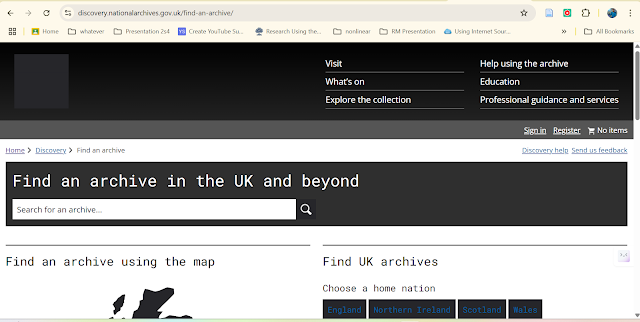
  •  In The National Archives website through Discovery option I was able to locate the collection ‘Alfred, Lord Tennyson (1809–92)’ and the Catalogue description was Papers.


  • Here i was able to find the collection ‘Alfred, Lord Tennyson (1809–92)’ which was under the collection ‘Parodies : a collection of several hundred ridiculous rhymes in imitation of known authors and their works, [ca. 1850-1950]’


  • The collection ‘Alfred, Lord Tennyson (1809–92)’ contains 7 Boxes, 45 Items and 21 envelopes.


11 Using the ‘Making of America Books’ website at the University of Michigan, http://quod.lib.umich.edu/cgi/t/text/text- idx?page=simple&c=moa, 

  • The Link was working and i was directed to the ‘Making of America Book’ Digital Collection 


search for the Edith Wharton short story ‘The Pelican’, which was published in Scribner’s Magazine, vol. 24, November 1898, pp. 620–9. 


  • From the Search There were 312 Results but ‘The Pelican’ was not in there


  • So, i went for Advanced Search by adding author name but still there were 0 matches 


  • I went to the home page and there was option of Title, Author and Subject wise search 

  • Title wise i Search for TH - there were 72 Results but the mentioned Work was not there

  • Author wise i Search for WH- (100 Results) but still there was no author with name  Edith Wharton (Wharton, Edith - as per the search)


Once you have located this story, either print it off or electronically download the text.


Understanding Academic Writing

This blog is written on the Academic Writing Videos by Atanu Bhattacharya and Kalyan Chattopadhyay, as part of the Ph.D. Coursework Task assigned by Dr. Dilip P. Barad Sir.


Defining Academic Writing: 

Academic writing is a formal style of writing used for papers, theses, and publications in journals. It differs from informal writing through its adherence to specific formal features. It is characterised by objective language, meaning it aims to present information in an unbiased way. We also have to in account that the use of Strong language, Technical terms and Jargons also Doesn't means that what is Presented is of very Good Quality, for example how Alan Sokal makes fun of Strong academic Language by Writing Article like Transgressing the boundaries: Towards a transformative Hermeneutics of Quantum Gravity. 
A key feature of Academic Writing  is cautious language or hedging, which involves avoiding strong, definitive statements and instead using phrases that indicate possibility or suggestion (e.g., "it seems," "perhaps," "may not be"). This caution stems from the nature of research, which often explores new areas or interpretations, and aims to avoid presenting findings as absolute truths.
Academic writing also frequently uses the passive voice and relies heavily on references and citations to attribute ideas and information to their original sources. These features collectively create a tone that is considered appropriate for academic discourse.

Structure and Organisation: 

As Mentioned in the Video by Atanu Bhattacharya, He Presents Swales’s CARS Model for the Organising the Academic Writing as Mostly similar pattern is Followed
  • Definition
  • Purpose
  • Justification
  • Literature Review
  • Method
  • Argument
  • Conclusion

Effective academic writing typically organises text into paragraphs, with each paragraph developing a specific aspect or idea related to the overall topic. A well-structured paragraph begins with a topic sentence or sentences that introduce the main problem or idea of that paragraph. This is followed by supporting sentences that develop the topic by providing evidence, examples, research findings, or arguments. These supporting sentences are crucial for backing up the claim made in the topic sentence. The paragraph concludes with a concluding sentence. It is important that the concluding sentence does not simply repeat the topic sentence. Instead, it should summarise the argument presented in the supporting sentences and demonstrate the progression of thought or how the discussion leads to a particular point or conclusion within that paragraph.


Signalling expressions (such as "initially," "as a result," "however," "although," "because of," "therefore") are words or phrases used to indicate the relationship between different ideas or sections of text. They help guide the reader through the argument and show the flow or structure of the writing. However, the sources advise using signalling expressions cautiously and selectively. Overusing them can suggest that the argument is not inherently well-structured and that the writer is merely trying to link disparate points. They are most effective when used to indicate shifts from one argument to another or when presenting a sequence of evidence. Excessive use might even prompt reviewers to request revisions.


Critical Writing: 

Writing critically in an academic context means making the best possible use of the material you have consulted. The process of critical writing involves careful thought, analysis, comparison, and decision-making. It requires actively questioning existing opinions or arguments, even those from established critics. You analyse the key elements of these opinions and compare them with views from other sources.

Based on this analysis and comparison, you make a decision about whether to accept, reject, or modify an argument or perspective. Accepting and including the ideas doesnt mean you take it as it is but you have to paraphrase it. You have to change your vocabulary and to establish your "own voice" in your writing. 


Literature Review and Justification: 

The literature review is a fundamental part of academic writing and research, serving several key roles in justifying your research questions and arguments. It involves reading widely in your field to understand existing knowledge, identify key concepts and definitions, and examine the arguments and perspectives of other scholars. By engaging with the literature, you demonstrate that you are aware of what has already been studied related to your topic.

The literature review helps justify your research questions by showing a gap in existing knowledge or an area that needs further exploration or a different perspective. It helps to situate your research within the broader academic conversation, showing how your work builds upon or diverges from previous studies.


Research Methods (as discussed):

 The Triangulation Method was discussed by Atanu Bhatacharya , particularly in the social sciences but Still it is also a Useful Method in the Humanities, as a way to determine causality by examining a topic from three different angles like Methods, Theory and Databases. This could involve using different types of data, theoretical frameworks, or research methods. The process of triangulation, by bringing together multiple perspectives, contributes to the analysis and interpretation presented in the academic writing.


Clarity and Accessibility: 

Clarity and accessibility are considered important qualities of good academic writing. While academic writing uses formal and specific vocabulary, the sources caution against making the writing overly technical or full of jargon that only a very small number of experts can understand. Writing that is difficult to read or understand can be ineffective, even if published in prestigious journals. The goal is to ensure that your message, analysis, and arguments reach your intended audience effectively. This means using precise language but defining necessary technical terms clearly, potentially drawing on definitions used by others or providing your own. Avoiding "technical mumbo jumbo" is essential for the writing to have impact and be readable.


Key Learnings and Application: 

There were many Important Takeaways from the videos that added up to the information of Academic Writing. Some of the points are Distinguishing Your Own Voice, Triangulation Method, The case study of Science Fiction study in India given by Atanu Bhatacharya. The Informal and Formal Use of vocabulary.


Organising Research Reading and Writing

Embarking on a research project can often feel like diving into an ocean of information, with the added pressure of synthesising it into a c...